It's a fair question, and one we hear a lot.
In fact, when I deliver community defibrillator training, this is often one of the first concerns people raise. The thought of being faced with a cardiac arrest is daunting enough. Add in a defibrillator, worried family members, and the pressure of knowing somebody's life may depend on your actions, and it's easy to understand why people worry about panicking.
The good news is that defibrillators are specifically designed for people who have never used one before.
You Don't Need to Remember Anything
One of the biggest misconceptions about defibrillators is that you need specialist knowledge to use them.
You don't.
Modern Automated External Defibrillators (AEDs) are designed to guide ordinary members of the public through an extraordinary situation.
Once the device is switched on, it immediately starts giving clear voice instructions. These prompts tell you exactly what to do, one step at a time.
You don't need to remember a training course.
You don't need to make medical decisions.
You simply listen and follow the instructions.
What If I Make a Mistake?
This is another common fear.
People often worry that they might accidentally harm someone by using a defibrillator incorrectly.
The reality is that the defibrillator does the thinking for you.
The device analyses the casualty's heart rhythm and decides whether a shock is required. If a shock is not needed, the AED will not allow one to be delivered.
You cannot accidentally shock someone whose heart does not require it.
In simple terms, you can't make the wrong decision because the machine makes that decision for you.
What Happens in Real Life?
Over many years working with defibrillators, I've seen people from all walks of life step forward to help during emergencies.
Very few of them were completely calm.
Most were nervous.
Some were frightened.
That's normal.
The important thing is that they acted.
Nobody expects you to be a paramedic. Nobody expects you to perform perfectly. What matters is recognising that somebody needs help, calling 999, starting CPR, and using the AED as soon as it arrives.
The person on the ground already has a life-threatening emergency. Taking action gives them a chance.
Doing nothing does not.
Why Defibrillators Talk to You
Manufacturers understand that people may be stressed, upset, or frightened when using an AED.
That's why the voice prompts are deliberately calm, simple, and easy to follow.
The device will guide you through:
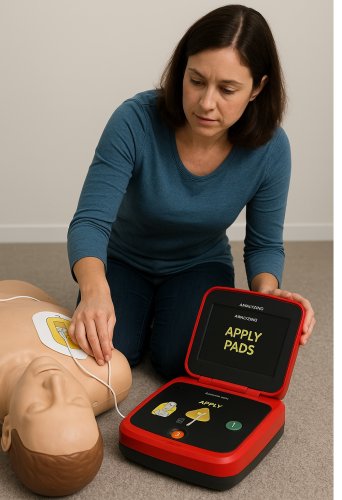
• Placing the electrode pads
• Standing clear while the heart rhythm is analysed
• Delivering a shock if one is required
• Continuing CPR between analyses
At every stage, the AED tells you what to do next.
Building Confidence Before an Emergency
If you're still worried about using a defibrillator, you're not alone.
The best way to build confidence is simply to see one in action.
A short demonstration or community awareness session is often enough to remove many of the fears people have about AEDs.
Most people are surprised by how straightforward the process actually is.
Final Thoughts
If you ever find yourself in a situation where somebody has collapsed and needs a defibrillator, remember this:
You don't need to be fearless.
You don't need to be an expert.
You don't need to be perfect.
You simply need to act.
Switch on the AED, listen to the voice prompts, and let the device guide you.
You might be nervous, but you could also be the person who gives someone their best chance of survival.
About Ken Hopkins
Ken Hopkins is an AED expert with more than 40 years' experience in defibrillation, multiparameter monitor defibrillators, pre-hospital ECG telemetry, community AED governance, training, and support.
Need advice about AEDs, training, servicing, or AED Aftercare?
Hopkins⁺ Training and Support is always happy to help.