The Short Answer
No.
Modern Automated External Defibrillators (AEDs) are designed to be extremely safe for both the casualty and the rescuer.
If used correctly, there is virtually no risk of the rescuer receiving a shock from the AED.
The device provides clear instructions throughout the rescue and will tell everyone to stand clear before a shock is delivered.
Simply following the voice prompts is usually all that's required.
Why Do People Believe This Myth?
It's easy to understand.
When people hear the words "electric shock", they naturally imagine electricity travelling through anyone nearby.
Television dramas often show dramatic scenes with sparks, shouting, and people being thrown backwards.
Real life is very different.
Modern AEDs are carefully designed medical devices with multiple safety systems built in to protect both the casualty and those helping them.
How Does the AED Keep Rescuers Safe?
The AED continuously guides the rescuer through the process.
When a shock is required, the device will clearly instruct everyone to stand clear of the casualty.
You'll typically hear prompts such as:
"Stand clear."
"Do not touch the patient."
"Shock advised."
These prompts are there for a reason.
The AED wants to ensure nobody is touching the casualty during shock delivery.
What Happens If Someone Is Touching the Casualty?
In training, this is one of the most common questions.
The answer is simple.
Before a shock is delivered, stop CPR, move your hands away, and ensure everyone else is clear.
Once the AED confirms it's safe, the shock can be delivered.
The entire process usually takes only a few seconds.
Immediately afterwards, CPR is resumed.
What Happens in Real Life?
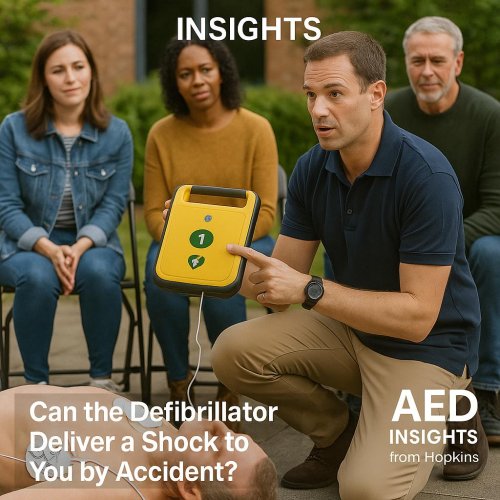
Over many years working with defibrillators, I've noticed that most people become much more comfortable once they see an AED being demonstrated.
The fear of receiving a shock tends to disappear once they understand how many safety features are built into the process.
The device doesn't rush.
It doesn't surprise you.
It talks you through every stage.
In reality, the AED is doing everything possible to keep both the casualty and the rescuer safe.
What About Rain or Wet Conditions?
This is another common concern.
Many cardiac arrests happen outdoors.
If the casualty is wet, the chest should be dried before applying the pads.
This helps the pads stick properly and allows the AED to analyse the heart rhythm accurately.
Rain itself is not normally a reason to avoid using an AED.
The priority remains helping the casualty while following the AED's instructions.
Can the AED Accidentally Shock Me Through the Pads?
No.
The electrical current travels between the electrode pads attached to the casualty.
The AED is designed so that the shock follows a controlled pathway through the chest.
Provided you are not touching the casualty when instructed to stand clear, you are not part of that pathway.
Why This Myth Matters
Because fear causes hesitation.
People worry:
"What if I get shocked?"
"What if I do something wrong?"
"What if I hurt myself?"
The reality is that the risk to the rescuer is extremely low when the AED is used as intended.
The greater risk is delaying treatment because of a misunderstanding.
What Should I Remember During a Rescue?
Keep it simple.
Call 999.
Start CPR.
Follow the AED's voice prompts.
When the device tells you to stand clear, stand clear.
When it tells you to resume CPR, resume CPR.
You don't need to understand the engineering behind the device.
You simply need to follow the instructions.
Final Thoughts
Let's put this myth to rest.
A properly used AED is designed to be safe for rescuers.
The device provides clear instructions.
It warns you before any shock is delivered.
It tells everyone to stand clear.
If you follow the prompts, there is virtually no risk of receiving a shock yourself.
The AED is there to help save a life.
Don't let fear of the equipment stop you from using it.
About Ken Hopkins
Ken Hopkins is an AED expert with more than 40 years' experience in defibrillation, multiparameter monitor defibrillators, pre-hospital ECG telemetry, community AED governance, training, and support.
Need advice about community defibrillators, governance, training, servicing, or AED Aftercare?
Hopkins⁺ Training and Support is always happy to help.