The Short Answer
False.
Public access defibrillators are often much easier to access than people realise.
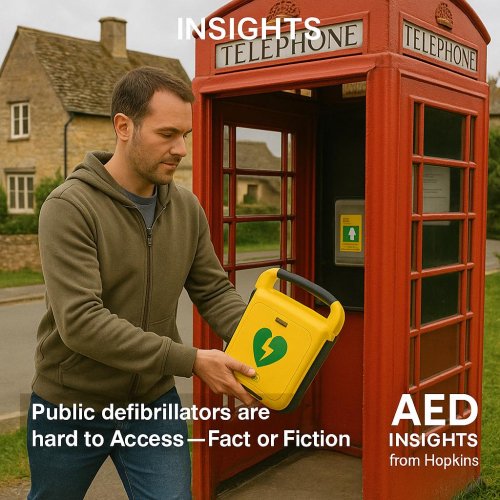
Thousands of AEDs are located throughout communities across the UK, including village halls, churches, schools, sports clubs, community centres, shops, workplaces, and even converted telephone boxes.
Many are available 24 hours a day, and emergency call handlers can often direct you to the nearest registered device during a 999 call.
Why Do People Believe This Myth?
Part of the problem is visibility.
Most people don't spend their day looking for defibrillators.
As a result, many assume there isn't one nearby.
Others have seen cabinets with keypad locks and assume access is restricted or complicated.
The reality is usually very different.
Most community AEDs are specifically positioned to be accessible during an emergency.
Where Are Public Defibrillators Usually Located?
Over the years, I've seen AEDs installed in all sorts of locations.
Common examples include:
• Village halls
• Churches
• Sports pavilions
• Schools
• Community centres
• Parish council buildings
• Shops and supermarkets
• Public houses
• Railway stations
• Former BT telephone kiosks
Many communities now have multiple AEDs covering different areas.
What Happens When You Call 999?
One of the most valuable resources available is the ambulance service itself.
When a cardiac arrest is suspected, the call handler may have access to information about nearby registered defibrillators.
They can often direct callers to the nearest available AED and, where necessary, provide an access code for locked cabinets.
Many people are surprised to learn how much support is available during a 999 call.
Why Are Some Cabinets Locked?
This is another source of confusion.
People sometimes assume a lock means the AED is difficult to access.
In reality, locks are usually there to reduce vandalism, theft, or misuse.
If the AED is registered correctly, the ambulance service can often provide the access code during an emergency call.
The lock is intended to protect the equipment, not prevent its use.
Are Unlocked Cabinets Better?
There's no single answer.
Some communities prefer unlocked cabinets because they provide immediate access.
Others prefer locked cabinets because of concerns about vandalism or misuse.
Both approaches can work successfully.
What's important is that the community understands how the AED can be accessed during an emergency.
What Happens in Real Life?
One thing I've learned over the years is that the biggest challenge is often awareness rather than access.
Many communities already have a defibrillator nearby.
The problem is that local residents don't know where it is.
That's why good signage, community awareness, and proper registration are so important.
A well-positioned AED can only help if people know it exists.
How Can I Find My Nearest AED?
There are several ways.
You can:
• Look for AED signage in your local area
• Ask your parish council or community organisation
• Check local community websites
• Use recognised AED location tools
• Follow guidance from 999 call handlers during an emergency
It's worth taking a few minutes today to find out where your nearest AED is rather than trying to locate one under pressure during an emergency.
Why Registration Matters
Installing an AED is only part of the process.
Registering it correctly is equally important.
A registered AED is far more likely to be identified and recommended by ambulance service call handlers when someone nearby suffers a cardiac arrest.
This is one reason why proper governance is so important.
An unregistered AED may be physically present but effectively invisible when it's needed most.
Final Thoughts
Let's bust this myth once and for all.
Public defibrillators are not hidden away behind layers of bureaucracy.
They are installed specifically so communities can access them during emergencies.
The biggest challenge is often knowing where they are before they're needed.
Take a few minutes to find your nearest AED today.
Hopefully you'll never need it.
But if the day comes when you do, you'll be glad you know where to find it.
About Ken Hopkins
Ken Hopkins is an AED expert with more than 40 years' experience in defibrillation, multiparameter monitor defibrillators, pre-hospital ECG telemetry, community AED governance, training, and support.
Need advice about community defibrillators, governance, training, servicing, or AED Aftercare?
Hopkins⁺ Training and Support is always happy to help.