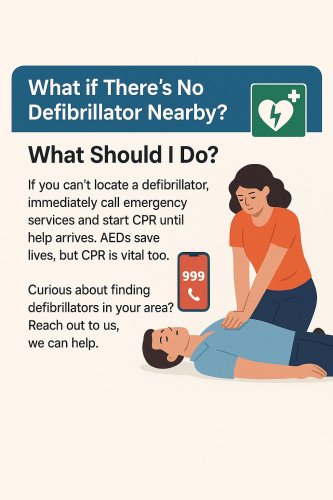
The short answer is simple.
Call 999, start CPR immediately, and continue until help arrives.
While a defibrillator can dramatically improve survival from cardiac arrest, CPR remains one of the most important things you can do when someone's heart has stopped. Even if there is no AED available, your actions can make a real difference.
The First Few Minutes Matter Most
When somebody suffers a cardiac arrest, their heart is no longer pumping blood effectively around the body.
Without oxygen, the brain and other vital organs begin to suffer damage within minutes.
This is why immediate action is so important.
If someone collapses, is unresponsive, and is not breathing normally, call 999 straight away and begin chest compressions.
Don't wait for an AED to arrive before doing something.
Start helping immediately.
What Does CPR Actually Do?
CPR does not restart the heart.
This surprises many people.
What CPR does is manually pump a small amount of blood around the body by compressing the chest.
Although this blood flow is limited, it helps deliver oxygen to the brain and vital organs until more advanced treatment can be provided.
Think of CPR as buying time.
Every minute that passes without CPR reduces the chance of survival.
Should Someone Go Looking for a Defibrillator?
Yes, if there are other people available.
One person should remain with the casualty and continue CPR.
Another person should call 999.
If additional help is available, someone can be sent to retrieve the nearest AED.
This is often where the ambulance service can help.
Emergency call handlers have access to information about many registered public access defibrillators and can direct callers to the nearest available device.
What If I'm On My Own?
This is a situation many people worry about.
If you are alone with an adult casualty who has suffered a cardiac arrest, call 999 immediately and put the phone on speaker mode if possible.
The call handler will guide you through what to do next.
Begin chest compressions and continue until help arrives or an AED becomes available.
The ambulance service would much rather hear you performing CPR than searching for a defibrillator several streets away while leaving the casualty unattended.
What Happens in Real Life?
Over the years, I've attended incidents where there was no defibrillator immediately available.
What made the difference wasn't the equipment.
It was the people who stepped forward and started CPR.
The reality is that bystanders are often the first link in the chain of survival.
Before the ambulance arrives.
Before the paramedics arrive.
Before any advanced equipment arrives.
There is often just an ordinary member of the public willing to help.
Does Every Cardiac Arrest Need a Defibrillator?
Not necessarily.
While many cardiac arrests are caused by shockable heart rhythms that benefit from defibrillation, others are not.
The important point is that you don't need to know the difference.
Start CPR.
Use an AED if one becomes available.
Let the equipment and healthcare professionals determine what treatment is needed.
Could CPR Alone Save a Life?
Yes.
Although survival rates are generally higher when CPR and early defibrillation are combined, there are many examples of people surviving because someone started CPR quickly.
Doing something is always better than doing nothing.
Final Thoughts
If there is no defibrillator nearby, don't let that stop you from acting.
Call 999.
Start CPR.
Follow the guidance of the emergency call handler.
If an AED becomes available, use it.
If it doesn't, continue CPR until help arrives.
Remember, the person in cardiac arrest needs immediate assistance. Your willingness to act may be the most important factor in giving them a chance of survival.
About Ken Hopkins
Ken Hopkins is an AED expert with more than 40 years' experience in defibrillation, multiparameter monitor defibrillators, pre-hospital ECG telemetry, community AED governance, training, and support.
Need advice about community defibrillators, training, servicing, governance, or AED Aftercare?
Hopkins⁺ Training and Support is always happy to help.