The Short Answer
Yes.
If someone with a pacemaker suffers a cardiac arrest, you should use a defibrillator exactly as you would for any other casualty.
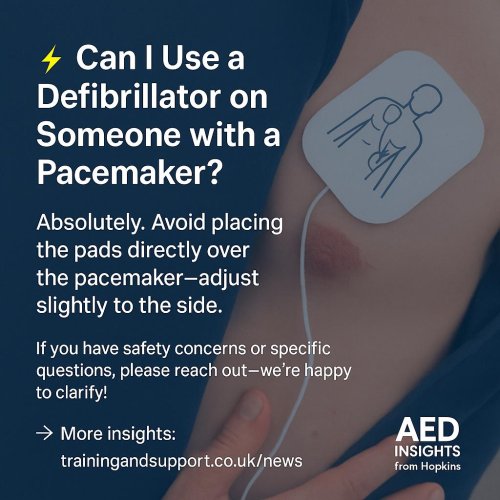
The only adjustment is to avoid placing the electrode pad directly over the pacemaker itself. If you can see or feel the pacemaker under the skin, position the pad slightly to one side.
Other than that, follow the AED's instructions as normal.
What Is a Pacemaker?
A pacemaker is a small electronic device implanted beneath the skin, usually just below the collarbone.
Its job is to help regulate the heart's rhythm by delivering tiny electrical impulses when required.
Many thousands of people across the UK live active, healthy lives with pacemakers.
If you've ever met someone with a small bump beneath the skin on the upper chest, there's a good chance you've met someone with a pacemaker.
Why Do People Worry About Using an AED?
It's a perfectly reasonable concern.
People often assume that because both devices involve electricity, they might interfere with each other.
Others worry that a shock from the AED could damage the pacemaker or somehow harm the casualty.
The good news is that AEDs and pacemakers are designed with this situation in mind.
Healthcare professionals use defibrillators on patients with pacemakers every day.
How Can I Tell If Someone Has a Pacemaker?
Often, you'll notice a small raised lump beneath the skin, usually on the upper left side of the chest just below the collarbone.
Sometimes there may also be a visible scar from the implantation procedure.
However, don't spend valuable time searching for one.
If you notice it while applying the pads, simply position the pad slightly away from the device.
If you don't notice it, the priority remains the same: get the pads on and let the AED begin analysing.
Where Should the Pads Be Placed?
The standard pad positions remain largely unchanged.
One pad is normally placed on the upper right side of the chest.
The second pad is placed on the left side of the chest below the armpit.
If a pacemaker sits directly where a pad would normally be placed, move the pad a short distance away, typically by a few centimetres.
The aim is simply to avoid placing the adhesive pad directly on top of the implanted device.
What If I Accidentally Place a Pad Over the Pacemaker?
Don't panic.
The most important thing is that the casualty receives treatment quickly.
While moving the pad slightly away is considered best practice, a brief delay while worrying about perfect pad placement is often more harmful than simply getting started.
Remember, the casualty is already experiencing a life-threatening emergency.
The priority is early CPR and early defibrillation.
Will the AED Still Work?
Absolutely.
Modern AEDs are designed to analyse the heart's rhythm regardless of whether a pacemaker is present.
The presence of a pacemaker does not prevent the AED from doing its job.
If a shockable rhythm is detected, the device will advise a shock.
If a shock is not required, it will tell you that too.
The AED continues to make the decisions.
You simply follow its instructions.
What Happens in Real Life?
As people live longer and receive more advanced cardiac treatments, it's becoming increasingly common to encounter casualties with pacemakers, implanted defibrillators, heart stents, and other medical devices.
This is one reason why community AED training often includes discussions about implanted devices.
In reality, however, the process remains straightforward.
Call 999.
Start CPR.
Apply the pads.
Follow the voice prompts.
The presence of a pacemaker changes very little about the overall response.
What About Implanted Defibrillators?
Some people have an implanted cardioverter defibrillator (ICD) rather than a standard pacemaker.
These devices can look very similar beneath the skin.
The same advice applies.
Avoid placing the AED pad directly over the implanted device if possible, but otherwise continue as normal.
Do not delay treatment.
Building Confidence
Many people are surprised by how often this question comes up.
In truth, it's another example of people wanting to do the right thing and worrying about causing harm.
The reality is that AEDs are designed to be used in real-world situations where casualties may have pacemakers, scars, medical conditions, and a variety of other circumstances.
You don't need to be an expert in recognising cardiac implants.
You simply need to act.
Final Thoughts
If someone with a pacemaker suffers a cardiac arrest, use the AED.
Don't delay treatment.
Don't worry about damaging the pacemaker.
If you notice the device, place the pad slightly away from it.
If you don't notice it, continue with the rescue.
The person in cardiac arrest needs immediate help, and the AED remains one of the most effective tools available to give them a chance of survival.
About Ken Hopkins
Ken Hopkins is an AED expert with more than 40 years' experience in defibrillation, multiparameter monitor defibrillators, pre-hospital ECG telemetry, community AED governance, training, and support.