The Short Answer
Yes.
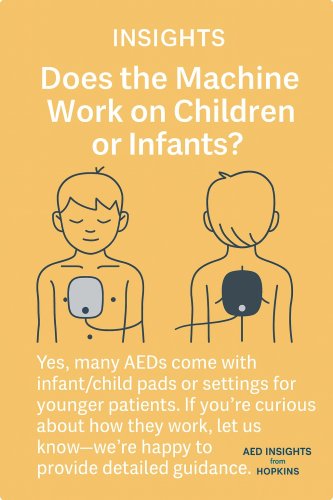
Many modern defibrillators can be used on children and infants, either by using child-specific electrode pads or by selecting a dedicated child mode on the device.
If a child suffers a cardiac arrest, using a defibrillator can be lifesaving. The most important thing is not to delay treatment while worrying about the equipment.
Call 999, start CPR, and use the AED as soon as it becomes available.
Why Do People Ask This Question?
Most people associate cardiac arrest with adults, particularly older adults.
As a result, many are surprised to learn that children and infants can also suffer cardiac arrest.
When they see a public access defibrillator, a common question follows:
"Will it work on a child?"
The answer is reassuringly simple. In most cases, yes.
Modern AEDs are designed to recognise and accommodate younger patients.
How Does a Defibrillator Treat Children?
The principle is exactly the same as for an adult.
The AED analyses the heart rhythm and determines whether a shock is required.
If a shock is needed, the device delivers an electrical current intended to restore a normal heart rhythm.
The difference is that children generally require less energy than adults.
That's why many AEDs include a way of reducing the energy delivered.
What Are Child Pads?
Many public access AEDs are supplied with optional child electrode pads.
These pads are designed for children typically under eight years of age.
When child pads are connected, the AED automatically reduces the shock energy to a level more suitable for a smaller patient.
The pads also include diagrams showing the correct placement for a child.
What Is Child Mode?
Some newer defibrillators don't require separate pads.
Instead, they include a child mode button or switch.
Activating child mode tells the AED to adjust its settings for a younger casualty.
This has several advantages:
• No need to locate separate pads
• Faster deployment during an emergency
• Reduced complexity for rescuers
• Lower ongoing consumable costs
This feature is becoming increasingly popular in community defibrillators.
What If Child Pads Aren't Available?
This is one of the most important things for people to understand.
If a child is in cardiac arrest and child pads are not available, use the AED with the adult pads.
Do not wait.
Do not decide against using the AED because you don't have the ideal equipment.
The risk from untreated cardiac arrest is far greater than the risk of using adult pads.
This is also the advice provided by resuscitation organisations around the world.
What About Infants?
Cardiac arrest in infants is rare, but it can happen.
Where available, child pads should be used.
If child pads are not available and the AED is the only option, emergency call handlers and current resuscitation guidelines support using the equipment rather than doing nothing.
As always, call 999 immediately and follow the advice of the emergency call handler.
What Happens in Real Life?
One thing I've noticed during training sessions is that many people assume a public defibrillator is "for adults only."
That's understandable.
Most community AEDs are installed because of concerns about adults suffering cardiac arrest.
However, schools, sports clubs, village halls, churches, and public spaces are used by people of all ages.
The reality is that many modern AEDs are perfectly capable of helping both adults and children.
That's one reason why I encourage organisations purchasing a new AED to consider how paediatric capability is provided and how easy it will be to use during a real emergency.
Should Every Community AED Have Child Capability?
In my opinion, yes.
Whether that's through dedicated child pads or a child mode button, it's sensible for a community AED to be able to support casualties of all ages.
The additional cost is usually small compared to the reassurance it provides.
More importantly, it means rescuers are not left wondering whether the equipment is suitable if a child collapses.
Final Thoughts
If a child or infant suffers a cardiac arrest, don't be afraid to use the AED.
Many modern devices are designed to treat younger patients safely and effectively.
If child pads or a child mode are available, use them.
If they aren't available, use the AED anyway.
The most important thing is to act quickly.
Call 999, start CPR, and use the equipment available to you.
When it comes to cardiac arrest, doing something is always better than doing nothing.
About Ken Hopkins
Ken Hopkins is an AED expert with more than 40 years' experience in defibrillation, multiparameter monitor defibrillators, pre-hospital ECG telemetry, community AED governance, training, and support.
Need advice about community defibrillators, governance, training, servicing, or AED Aftercare?
Hopkins⁺ Training and Support is always happy to help.