The Short Answer
The good news is that you don't need to guess.
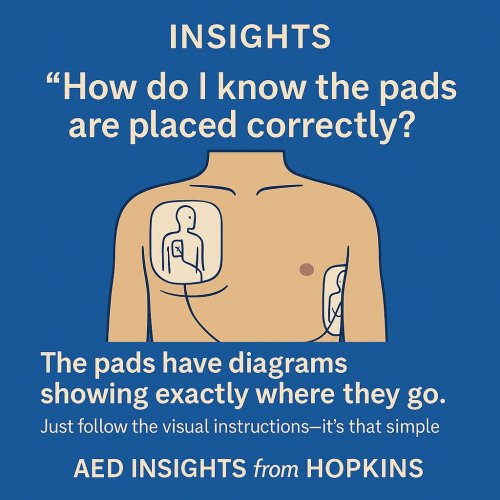
Every set of defibrillator pads has clear diagrams printed directly on the packaging and on the pads themselves, showing exactly where they should be placed. Modern AEDs are designed to make the process as simple as possible, even for someone who has never used one before.
If you follow the pictures, you're very unlikely to go wrong.
Why Do People Worry About Pad Placement?
This is one of the most common questions people ask during training sessions.
Many people worry that placing the pads incorrectly could prevent the defibrillator from working or somehow harm the casualty.
It's understandable. Most of us have never needed to use a defibrillator in real life, and when faced with an emergency, it's natural to question whether we're doing things correctly.
The reassuring news is that AED manufacturers know this.
That's why pad placement has been designed to be simple, visual, and easy to understand under pressure.
Where Do the Pads Go?
For an adult casualty, one pad is normally placed on the upper right side of the chest, just below the collarbone.
The second pad is placed on the left side of the chest, below the armpit.
This positioning allows the electrical current to pass through the heart effectively if a shock is required.
Fortunately, you don't need to memorise this.
The diagrams printed on the pads show exactly where they belong.
Simply copy the picture.
Why Is This Position Important?
The pads are positioned to allow the AED to analyse the heart's electrical activity accurately and, if necessary, deliver a shock through the heart muscle.
Think of the pads as creating a pathway across the chest.
The exact positioning helps the AED perform both of its important jobs:
• Analysing the heart rhythm
• Delivering a shock if required
The diagrams supplied with the pads are based on decades of research and clinical experience.
What If I Don't Get Them Perfectly Right?
This is where many people overthink the process.
In a real emergency, "good enough" is usually far better than spending precious minutes worrying about achieving perfection.
If the pads are broadly in the correct positions shown in the diagram, the AED will usually be able to analyse the heart rhythm effectively.
The biggest mistake isn't placing the pads slightly off position.
The biggest mistake is delaying treatment because you're worried about getting it exactly right.
What Happens in Real Life?
One thing I've learned over many years working with defibrillators is that people often underestimate themselves.
During training, someone might spend several minutes carefully studying the diagrams.
During a real emergency, most people place the pads surprisingly quickly and accurately.
The reason is simple.
The instructions are clear.
The diagrams are easy to follow.
And the urgency of the situation focuses attention on helping the casualty rather than worrying about technical details.
What About Hairy Chests?
This question comes up surprisingly often.
A very hairy chest can sometimes prevent the pads from sticking properly to the skin.
Many public access defibrillators include a responder kit containing trauma shears and a razor for this reason.
If excessive chest hair prevents good pad contact, a small area can be shaved quickly before applying the pads.
The important thing is not to spend excessive time doing this. If the pads appear to be making good contact with the skin, proceed with the rescue.
What About Jewellery, Pacemakers or Medical Devices?
If the casualty has a pacemaker or implanted device, you may notice a small lump beneath the skin, usually just below the collarbone.
Simply place the pad slightly away from the device rather than directly over it.
Jewellery generally isn't a problem unless it sits directly beneath a pad.
Again, the goal is good pad contact with the skin.
Let the AED Guide You
Once the pads are attached, the AED takes over.
The device will analyse the heart rhythm and tell you exactly what to do next.
If a shock is required, it will advise you.
If a shock is not required, it will tell you that too.
Your job is simply to apply the pads and follow the prompts.
The AED does the complicated part.
Building Confidence Before an Emergency
If you've never seen AED pads before, it's perfectly normal to feel uncertain.
A quick hands-on demonstration can make a huge difference.
Most people are surprised by how straightforward the process actually is once they've handled the equipment themselves.
Confidence doesn't come from reading instructions.
It comes from familiarity.
Final Thoughts
If you're worried about placing the pads correctly, remember this:
The diagrams are there to guide you.
You don't need medical training.
You don't need to memorise complicated instructions.
You don't need to achieve perfection.
Follow the pictures, attach the pads, and let the AED do its job.
The person in cardiac arrest needs help, and your willingness to act is far more important than achieving textbook-perfect pad placement.
About Ken Hopkins
Ken Hopkins is an AED expert with more than 40 years' experience in defibrillation, multiparameter monitor defibrillators, pre-hospital ECG telemetry, community AED governance, training, and support.
Need advice about community defibrillators, governance, training, servicing, or AED Aftercare?
Hopkins⁺ Training and Support is always happy to help.