The Short Answer
Immediately.
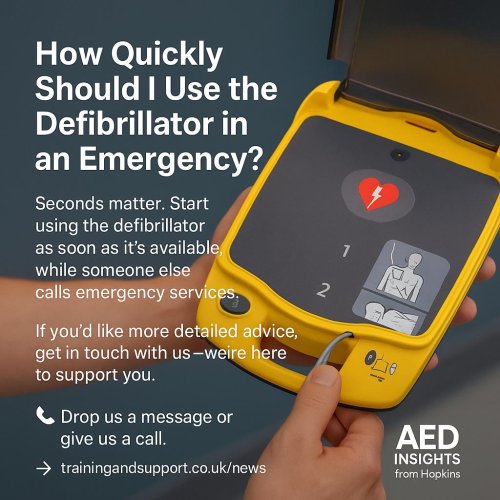
If someone has collapsed, is unresponsive, and is not breathing normally, call 999, start CPR, and use the defibrillator as soon as it becomes available.
When it comes to cardiac arrest, every minute counts. The sooner CPR is started and the sooner a defibrillator is used, the greater the chance of survival.
Why Does Speed Matter?
A cardiac arrest is different from a heart attack.
During a cardiac arrest, the heart suddenly stops pumping blood effectively around the body.
Without blood flow, the brain and other vital organs are deprived of oxygen.
This is why immediate action is so important.
Every minute that passes without treatment reduces the chance of survival.
The first few minutes can make a significant difference to the outcome.
Should I Start CPR First or Use the Defibrillator?
Ideally, both should happen as quickly as possible.
If another person is present, one person should call 999 and begin CPR while another retrieves the AED.
If the AED is immediately available, switch it on and follow the prompts.
The device will guide you through the process while ensuring CPR continues whenever possible.
Think of CPR and defibrillation as partners rather than alternatives.
Each has an important role to play.
Why Can't I Just Wait for the Ambulance?
This is a question many people don't think about until an emergency happens.
Even with an excellent ambulance service, somebody has to provide help during those critical first minutes.
That's where members of the public make a huge difference.
The chain of survival often starts long before the first ambulance arrives.
The person who calls 999.
The person who starts CPR.
The person who fetches the AED.
These actions can all have a direct impact on survival.
What Happens if the AED Arrives Several Minutes Later?
Use it immediately.
Do not assume it's "too late."
Continue CPR until the AED is available and then follow the voice prompts.
The device will analyse the casualty's heart rhythm and advise whether a shock is required.
Even if several minutes have passed, the AED may still play a vital role in the resuscitation attempt.
What Happens in Real Life?
One thing I've learned over many years working with defibrillators is that people often underestimate how quickly events unfold.
A person can appear perfectly well one moment and collapse the next.
In those situations, the biggest enemy is often hesitation.
People worry about doing the wrong thing.
They worry about looking foolish.
They worry about whether they should wait for someone more qualified.
The reality is that immediate action is usually far more important than perfect action.
The people who make the biggest difference are often ordinary members of the public who decide to step forward and help.
Does the Defibrillator Need to Be Used Within a Certain Time?
The simple answer is: as soon as possible.
Cardiac arrest doesn't come with a stopwatch, and every situation is different.
What we do know is that earlier defibrillation generally offers the best opportunity for a successful outcome when a shockable rhythm is present.
That's why community AED programmes exist.
The goal is to make defibrillators available close to where people live, work, and spend their time.
Building Confidence Before an Emergency
Many people delay because they are unsure what to do.
The best way to overcome this is familiarity.
Take a look at your local AED.
Find out where it is.
Understand how to access it.
Attend a community awareness session if one is available.
Confidence comes from knowing that if the worst happens, you'll already have a basic understanding of what to do.
Final Thoughts
If someone suffers a cardiac arrest, don't wait.
Call 999.
Start CPR.
Use the AED as soon as it becomes available.
The defibrillator is designed to help you.
The ambulance service will support you.
Most importantly, the casualty needs somebody willing to act.
You don't need to be a healthcare professional.
You simply need to get started.
About Ken Hopkins
Ken Hopkins is an AED expert with more than 40 years' experience in defibrillation, multiparameter monitor defibrillators, pre-hospital ECG telemetry, community AED governance, training, and support.
Need advice about community defibrillators, governance, training, servicing, or AED Aftercare?
Hopkins⁺ Training and Support is always happy to help.