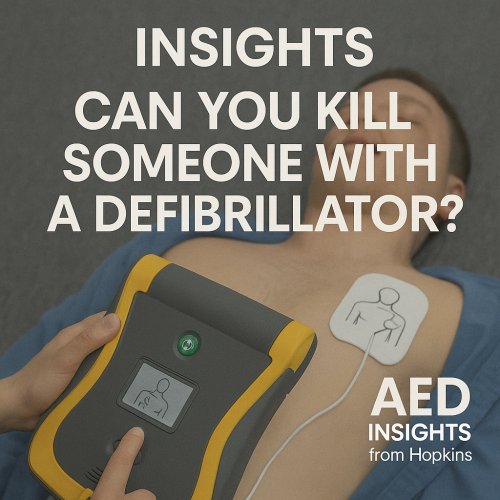
The Short Answer
No.
A public access defibrillator is designed to save lives, not take them.
Modern Automated External Defibrillators (AEDs) analyse the casualty's heart rhythm and only deliver a shock if one is medically appropriate.
If a shock is not needed, the device will not allow one to be delivered.
You cannot accidentally shock someone whose heart does not require it.
Why Do People Ask This Question?
It's an understandable fear.
Most people have little experience of medical equipment, and the word "electricity" naturally sounds intimidating.
Many imagine that a defibrillator delivers a powerful shock regardless of the circumstances.
Others worry that they might somehow make the casualty worse by using it incorrectly.
In reality, modern AEDs are specifically designed to remove those risks.
What Does a Defibrillator Actually Do?
Contrary to popular belief, a defibrillator doesn't restart a stopped heart.
Instead, it is designed to treat specific life-threatening heart rhythms.
During some cardiac arrests, the heart's electrical system becomes chaotic.
Rather than pumping blood effectively, the heart muscle quivers in a disorganised way.
The purpose of the shock is to interrupt that abnormal electrical activity and give the heart an opportunity to re-establish a normal rhythm.
The AED isn't creating the problem.
It's attempting to correct it.
What If the Person Doesn't Need a Shock?
This is where modern technology comes into its own.
Before delivering any shock, the AED analyses the heart rhythm.
The device decides whether a shock is likely to help.
If the answer is no, it simply won't deliver one.
The machine is constantly protecting both the casualty and the rescuer from inappropriate treatment.
What If I Press the Wrong Button?
Many people worry about this.
The reassuring truth is that the AED remains in control.
Even on semi-automatic devices where the rescuer presses a shock button, the machine will only enable that button if a shock has already been deemed necessary.
You cannot force the device to shock someone who doesn't require it.
What Happens in Real Life?
Over many years working with defibrillators, I've met countless people who were worried about causing harm.
The reality is usually the opposite.
The greatest danger in a cardiac arrest isn't that somebody will use the AED.
The greatest danger is that nobody does.
Every minute spent hesitating reduces the casualty's chances of survival.
The person who steps forward and follows the AED's instructions is giving that casualty an opportunity they would not otherwise have.
What About Someone Who Is Conscious?
This is another common concern.
People sometimes imagine attaching an AED to someone who is awake and accidentally shocking them.
Modern AEDs simply don't work that way.
If the casualty is conscious, talking, and has a normal heart rhythm, the AED will not identify a shockable rhythm.
No shock will be delivered.
The device is designed specifically to prevent inappropriate shocks.
Why This Myth Matters
Fear can be a powerful barrier.
If people believe they might accidentally kill someone with a defibrillator, they may avoid using it altogether.
That's exactly the opposite of what we want.
Public access defibrillators exist because early intervention saves lives.
The devices have been developed so that ordinary members of the public can use them safely and confidently.
The Bigger Risk
It's important to keep things in perspective.
If someone requires a defibrillator, they are already experiencing a life-threatening emergency.
Without treatment, survival is unlikely.
Using an AED is not introducing a new danger.
It is attempting to reverse an existing one.
That's a very important distinction.
Final Thoughts
Let's put this myth to rest once and for all.
You cannot kill someone by using a public access defibrillator correctly.
The AED analyses the heart rhythm.
The AED decides whether a shock is needed.
The AED prevents inappropriate shocks.
Your role is simple.
Call 999.
Start CPR.
Follow the voice prompts.
The machine does the rest.
If someone is suffering a cardiac arrest, your willingness to act could make all the difference.
About Ken Hopkins
Ken Hopkins is an AED expert with more than 40 years' experience in defibrillation, multiparameter monitor defibrillators, pre-hospital ECG telemetry, community AED governance, training, and support.
Need advice about community defibrillators, governance, training, servicing, or AED Aftercare?
Hopkins⁺ Training and Support is always happy to help.