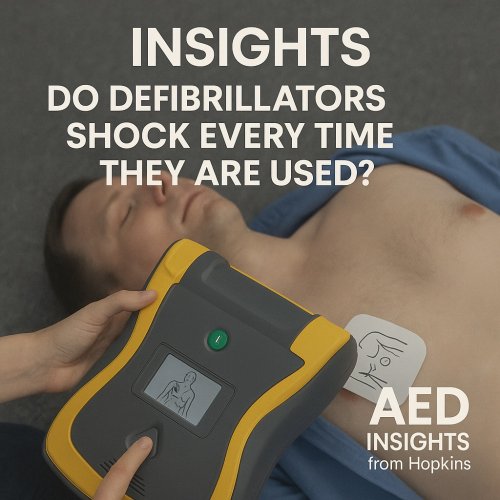
The Short Answer
No.
A defibrillator only delivers a shock when it detects a heart rhythm that can benefit from defibrillation.
If a shock is not needed, the AED simply won't allow one to be delivered.
This is one of the reasons modern Automated External Defibrillators (AEDs) are so safe for members of the public to use.
Why Do People Believe This Myth?
Movies and television have a lot to answer for.
Many people assume that a defibrillator's job is to shock everyone whose heart has stopped.
Others imagine that once the pads are attached, the machine automatically delivers electricity whether it's needed or not.
In reality, modern AEDs are far more sophisticated than that.
Their first job isn't delivering a shock.
Their first job is deciding whether a shock is required at all.
What Happens When the AED Is Switched On?
Once the pads are attached to the casualty's chest, the AED begins analysing the heart's electrical activity.
The device examines the rhythm and determines whether it is one that may respond to defibrillation.
Only after this analysis does the AED decide what happens next.
The machine will either advise a shock or advise that no shock is required.
What Happens if a Shock Is Needed?
If the AED detects a shockable rhythm, it will clearly tell the rescuer what to do.
Depending on the type of AED, it may:
• Ask the rescuer to press a shock button
• Deliver the shock automatically after warning everyone to stand clear
The process is controlled by the device, not the user.
What Happens if a Shock Isn't Needed?
This is where the myth falls apart.
If the AED determines that a shock will not help the casualty, it simply won't deliver one.
Instead, it will usually instruct the rescuer to continue CPR.
No amount of button pressing, guessing, or wishful thinking can force the AED to shock someone when it isn't medically appropriate.
The machine is specifically designed to prevent that from happening.
Does Every Cardiac Arrest Require a Shock?
No.
This surprises many people.
Some cardiac arrests involve heart rhythms that respond well to defibrillation.
Others do not.
This is one reason why CPR remains so important.
The AED analyses the rhythm and decides whether defibrillation is likely to help.
You don't need to understand the technical details.
The device does that for you.
What Happens in Real Life?
One of the questions I often hear during training is:
"What if I accidentally shock someone who doesn't need it?"
The answer is simple.
You won't.
Modern AEDs are designed specifically to prevent that situation.
Over the years, I've seen countless people gain confidence the moment they understand that the machine is making the decision, not them.
Suddenly the fear of "getting it wrong" starts to disappear.
Why Is This Important?
Because fear creates hesitation.
If people believe the AED will automatically shock anyone it's attached to, they may delay using it.
They may wait for somebody more qualified.
They may avoid acting altogether.
Understanding how the device actually works removes one of the biggest barriers to public confidence.
Can the AED Make a Mistake?
Modern AEDs are developed using extensive clinical research and are designed to analyse heart rhythms with a very high degree of accuracy.
While no medical technology is perfect, these devices are specifically engineered to ensure shocks are only advised when appropriate.
That's why they are trusted for use by members of the public around the world.
Final Thoughts
Let's bust this myth once and for all.
Defibrillators do not shock every time they are used.
Their first job is to analyse the heart rhythm.
Only if a shock is likely to help will the AED advise or deliver one.
You are not deciding whether a shock is needed.
The machine is.
That's what makes public access defibrillators such powerful and safe lifesaving tools.
About Ken Hopkins
Ken Hopkins is an AED expert with more than 40 years' experience in defibrillation, multiparameter monitor defibrillators, pre-hospital ECG telemetry, community AED governance, training, and support.
Need advice about community defibrillators, governance, training, servicing, or AED Aftercare?
Hopkins⁺ Training and Support is always happy to help.