The Short Answer
False.
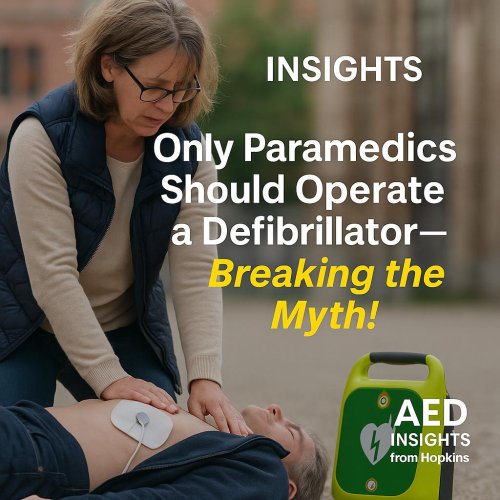
Public access defibrillators are specifically designed so that anyone can use them.
You do not need to be a paramedic.
You do not need to be a doctor.
You do not need to be a nurse or a first aider.
If someone suffers a cardiac arrest, a member of the public can use an AED and potentially save a life.
In fact, that's exactly why community defibrillators exist.
Why Do People Believe This Myth?
Many people associate defibrillators with ambulances, hospitals, and television medical dramas.
When they think about defibrillation, they picture highly trained healthcare professionals using sophisticated equipment.
As a result, they assume defibrillators must be complicated or require specialist knowledge.
Modern public access defibrillators couldn't be more different.
They have been designed from the ground up to be used by ordinary people during extraordinary situations.
Why Were Public Defibrillators Invented?
The simple answer is time.
When someone suffers a cardiac arrest, every minute matters.
Even the fastest ambulance service cannot be everywhere instantly.
That's why public access defibrillators have been installed in:
• Village halls
• Sports clubs
• Schools
• Churches
• Community centres
• Shops
• Railway stations
• Workplaces
The aim is simple.
Get lifesaving treatment to the casualty before professional help arrives.
How Does the AED Help the User?
Modern AEDs are remarkably clever.
Once switched on, they provide clear voice prompts that guide the rescuer through every stage of the process.
The device will tell you:
• When to apply the pads
• Where to place them
• When to stand clear
• Whether a shock is advised
• When to restart CPR
You don't need to remember a sequence.
You don't need to make a diagnosis.
You simply follow the instructions.
What If I've Never Seen One Before?
This is one of the biggest fears people have.
The good news is that many people who successfully use an AED have never used one before.
That's because the device is designed for exactly that situation.
The manufacturers know that the user may be frightened, stressed, and completely unfamiliar with the equipment.
The voice prompts are designed to guide you through the rescue one step at a time.
What Happens in Real Life?
During community training sessions, I often hear people say:
"I'd rather wait for the ambulance."
Unfortunately, cardiac arrest doesn't wait.
The reality is that many successful rescues begin with an ordinary member of the public taking action before healthcare professionals arrive.
Over the years I've seen teachers, shop workers, neighbours, parents, sports coaches, and passers-by step forward to help.
None of them were paramedics.
They were simply people who decided to act.
Why Confidence Matters More Than Qualifications
One of the biggest barriers to survival is hesitation.
People worry about doing the wrong thing.
They worry they aren't qualified.
They worry someone else might be better placed to help.
The truth is that the casualty doesn't need the perfect rescuer.
They need a willing rescuer.
The person who starts CPR, fetches the AED, and follows the prompts is already giving that casualty a better chance than someone who stands back waiting for a professional to arrive.
Is Training Still Useful?
Absolutely.
Training builds confidence.
It removes fear.
It allows people to handle the equipment before they encounter it during a real emergency.
But training is not a requirement.
It is a confidence builder, not a licence to use the equipment.
The AED is available to everyone.
Final Thoughts
Let's put this myth to rest.
Public access defibrillators are not reserved for paramedics.
They are not reserved for doctors.
They are not reserved for healthcare professionals.
They are there for anyone willing to help.
If someone suffers a cardiac arrest, don't wait for somebody with a uniform.
Call 999.
Start CPR.
Use the AED.
The device will guide you through the rest.
About Ken Hopkins
Ken Hopkins is an AED expert with more than 40 years' experience in defibrillation, multiparameter monitor defibrillators, pre-hospital ECG telemetry, community AED governance, training, and support.
Need advice about community defibrillators, governance, training, servicing, or AED Aftercare?
Hopkins⁺ Training and Support is always happy to help.