The Short Answer
No.
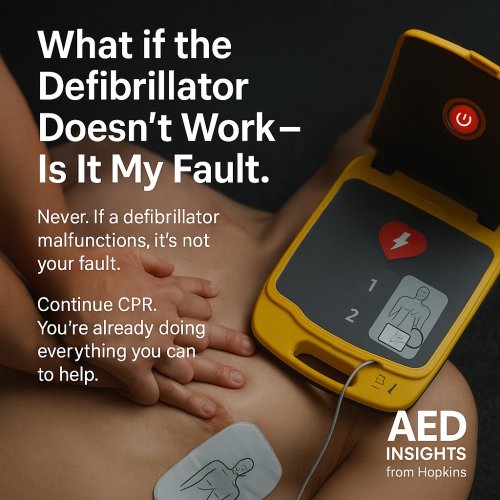
If a defibrillator doesn't work during an emergency, it is not your fault.
Modern Automated External Defibrillators (AEDs) are designed to be extremely reliable and perform regular self-checks to ensure they are ready for use. However, like any piece of equipment, faults can occasionally occur.
If an AED develops a problem, the most important thing is to continue CPR and follow the guidance of the emergency call handler.
The fact that you stepped forward to help is what matters.
Why Do People Worry About This?
Most people are willing to help in an emergency, but many are worried about responsibility.
They wonder:
"What if I do everything right and the machine doesn't work?"
"What if something goes wrong?"
"Will people blame me?"
These are natural concerns.
Nobody wants to make a difficult situation worse.
The reassuring reality is that if an AED fails, responsibility does not fall on the person attempting to save a life.
How Reliable Are Public Defibrillators?
Very reliable.
Modern AEDs constantly monitor themselves.
Many perform daily, weekly, and monthly self-tests.
They check:
• Battery condition
• Internal electronics
• Software integrity
• Shock delivery systems
• Overall operational readiness
This is why most AEDs display a clear status indicator showing whether they are rescue ready.
Manufacturers know these devices may sit unused for years before being needed, so reliability is a major part of their design.
Can Defibrillators Fail?
Like any electronic equipment, they can.
A battery may reach the end of its life.
Electrode pads may expire.
A component may develop a fault.
Water ingress, vandalism, accidental damage, or poor maintenance can also create problems.
Fortunately, these situations are uncommon, especially when the AED is properly maintained.
What Should I Do if the AED Doesn't Work?
Stay calm.
The most important thing is to continue CPR.
If the AED displays an error message, fails to power on, or behaves unexpectedly:
• Continue chest compressions
• Follow instructions from the 999 call handler
• Send someone to look for another AED if available
• Continue caring for the casualty until professional help arrives
Remember that CPR remains one of the most important treatments for cardiac arrest.
The absence of a working AED does not mean you stop helping.
What Happens in Real Life?
Over the years I've inspected, serviced, repaired, and supported thousands of defibrillators.
Most perform exactly as intended when needed.
Occasionally, however, we discover issues during routine inspections.
Sometimes batteries have expired.
Sometimes pads are out of date.
Sometimes a device develops a fault that nobody was aware of.
That's one reason why governance and regular inspections matter so much.
The good news is that these problems are usually identified during routine checks rather than during a rescue attempt.
Why AED Governance Matters
Many organisations install a defibrillator with the best intentions.
The challenge comes afterwards.
Who's checking it?
Who's monitoring expiry dates?
Who's replacing consumables?
Who's ensuring it's still registered and rescue ready?
An AED is not a fit-and-forget device.
Like any safety equipment, it needs ongoing attention.
Regular inspections dramatically reduce the risk of problems being discovered when the device is needed most.
Is It My Responsibility to Check the AED?
Not usually.
If you're a member of the public responding to an emergency, your responsibility is simple:
Call 999.
Start CPR.
Use the AED if one is available.
You are not expected to know the maintenance history of the device.
You are not expected to troubleshoot faults.
You are not expected to be an engineer.
You are simply trying to help someone in a life-threatening emergency.
The Bigger Picture
It's worth remembering why the AED is being used in the first place.
The casualty is already experiencing a cardiac arrest.
Without intervention, survival is unlikely.
By stepping forward and attempting to help, you've already made a positive difference.
Even if the AED develops a fault, your actions matter.
Your CPR matters.
Your willingness to act matters.
The fault is not yours.
Final Thoughts
If a defibrillator doesn't work during an emergency, don't blame yourself.
Continue CPR.
Follow the guidance of the emergency call handler.
Look for another AED if one is available.
Most importantly, remember that you chose to help when someone needed you.
That's what truly matters.
The greatest mistake is rarely using an AED incorrectly.
The greatest mistake is allowing fear to stop you from acting at all.
About Ken Hopkins
Ken Hopkins is an AED expert with more than 40 years' experience in defibrillation, multiparameter monitor defibrillators, pre-hospital ECG telemetry, community AED governance, training, and support.
Need advice about community defibrillators, governance, training, servicing, or AED Aftercare?
Hopkins⁺ Training and Support is always happy to help.