The Short Answer
No.
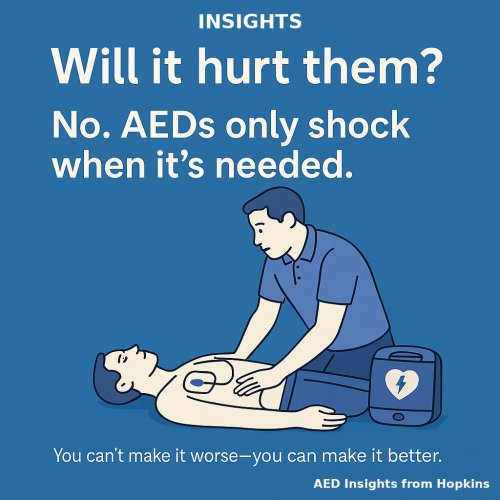
If someone is in cardiac arrest, using a defibrillator will not hurt them. In fact, it may be their best chance of survival.
Modern Automated External Defibrillators (AEDs) are designed to analyse the casualty's heart rhythm and will only deliver a shock if one is medically required. If a shock is not needed, the device simply won't allow one to be delivered.
You are not hurting someone by using an AED. You are giving them the best possible chance of recovery.
Why Do People Worry About This?
It's a completely understandable concern.
Many people have seen dramatic scenes on television where a patient jumps off the bed as a defibrillator shock is delivered. Others worry that electricity sounds dangerous and fear they could make the situation worse.
When faced with a real emergency, those concerns can create hesitation.
Unfortunately, hesitation is exactly what we don't want during a cardiac arrest.
Every minute without effective treatment reduces the chance of survival.
What Does a Defibrillator Actually Do?
A defibrillator doesn't "start" the heart.
This is one of the biggest misconceptions about AEDs.
In many cardiac arrests, the heart enters a chaotic electrical rhythm called ventricular fibrillation. Instead of pumping blood around the body, the heart muscle simply quivers.
The purpose of the shock is to stop that chaotic electrical activity and give the heart an opportunity to restart with a normal rhythm.
In simple terms, the shock is not causing harm. It is attempting to correct a life-threatening problem that is already present.
What If the Person Doesn't Need a Shock?
This is where modern AED technology is incredibly clever.
Before delivering any shock, the AED analyses the person's heart rhythm.
If a shock is required, the device will tell you.
If a shock is not required, the device will tell you that as well.
You cannot accidentally override this process.
You cannot force the AED to deliver a shock.
You cannot make the wrong decision because the machine makes that decision for you.
This is one of the reasons public access defibrillators can safely be used by members of the public without medical training.
Is the Shock Painful?
People often ask whether the shock hurts.
In reality, someone who is in cardiac arrest is unconscious and clinically unresponsive.
They are not aware of the shock in the way a conscious person would be.
The priority at that moment is not comfort. The priority is restoring a heart rhythm capable of sustaining life.
What Happens in Real Life?
Over many years working with defibrillators, I've seen one common theme.
The people who step forward to help are often worried about causing harm.
The reality is usually the opposite.
The greatest risk during a cardiac arrest is not that somebody will use a defibrillator.
The greatest risk is that nobody does.
Every successful resuscitation starts because somebody was prepared to act.
Not because they were confident.
Not because they were medically trained.
But because they decided to help.
Remember What the Alternative Is
It's important to keep things in perspective.
If a person requires a defibrillator, they are already experiencing a life-threatening medical emergency.
Without intervention, the outlook is poor.
Using a defibrillator is not introducing a new risk.
It is attempting to reverse the emergency that is already happening.
That's a very important distinction.
Building Confidence
Many people's fears disappear once they see an AED in action.
A short demonstration is often enough to show just how straightforward and safe these devices are.
Modern AEDs are designed to guide ordinary people through extraordinary circumstances.
You don't need to be a healthcare professional.
You don't need to remember complex procedures.
You simply need to switch on the AED and follow the voice prompts.
Final Thoughts
If you ever find yourself asking, "Will I hurt them if I use the defibrillator?", remember this:
The device will only deliver a shock if one is needed.
You cannot accidentally shock someone who doesn't require it.
You cannot make the wrong decision because the AED makes that decision for you.
The person in cardiac arrest needs immediate help.
By using the defibrillator, you are not hurting them.
You are giving them their best chance of survival.
About Ken Hopkins
Ken Hopkins is an AED expert with more than 40 years' experience in defibrillation, multiparameter monitor defibrillators, pre-hospital ECG telemetry, community AED governance, training, and support.
Need advice about community defibrillators, governance, training, servicing, or AED Aftercare?
Hopkins⁺ Training and Support is always happy to help.